Showing posts with label from the archives. Show all posts

Wednesday, May 6, 2015

"Here She Comes; It's Killing Time" (From the Archives)

You remember that time when I was talking about how Franz Ferdinand sounded to me like the soundtrack to 1960s Britain? Turns out that Karen Elson is their long-lost counterpart or something, because her first album, The Ghost Who Walks, gives me that same feeling, but in a different way.


Now, as it happens, Karen Elson is more well-known for one of two things: either her (now-dissolved) marriage to Jack White of the White Stripes or her modeling career. In fact, she is one of my favorite models ever, thanks to her always perfect facial expressions and the way she carries herself (and, as a side note, she replaced Angelina Jolie as the face of St. John a few years ago and did very well, in my opinion). And while I think that modeling is her true calling, she's done a bang-up job of putting an album together, as well.

Coming in at around 42 1/2 minutes, it's not a particularly long album (the longest song runs 4:21, but most range between 3:00 and 3:50). But in twelve tracks, Elson covers a good deal of ground. The title track has a distinct 60s-era garage sound, possibly influenced by Jack White, although Elson strikes me as the kind of person who came to this sound on her own, and that's why she and White are such a good match. Something interesting to note about "The Ghost Who Walks" is that it works just as well acoustically as it does with a full band, and in fact, the first time I ever heard it was the acoustic way. See here for the acoustic and here for the full band. Note, though, that these videos were recorded live, so even the full-band version sound as little different than the album cut. The upshot of this is that you realize that she's not just some overproduced rock star's wife--she actually knows what she's doing.

In contrast to the garage sound are the more country-influenced tracks, "Lunasa," "Cruel Summer," "The Last Laugh," and "Mouths to Feed" (and when I say country, I mean the more classic country sound, like the kind of songs you'd hear on the O Brother, Where Art Thou? soundtrack). Other sounds also abound. "100 Years from Now" is a strange carnival-type song and has a Mary Poppins kind of vibe to it. There's a certain kind of urgency to "Garden," and it calls to mind the very best aspects of 1990s alternative music. "The Thief at My Door" sounds almost like Sheryl Crow's "Weather Channel."


But for me, the tracks that stand out the most are "Stolen Roses," "The Truth Is in the Dirt," and "Pretty Babies." "Stolen Roses" sounds a bit like the flip side of Madonna's "La Isla Bonita 2008" with its Roma-influenced tones. But at the same time, it takes the country influence, and I can almost hear Hank Williams singing this song. "The Truth Is in the Dirt," on the other hand, pulls more of the garage rock sound in, fusing it with a blues-type structure, evident in the repetition of certain lines. And in a way, the chorus is almost a battle cry: "Here she comes; it's killing time. / Flames are burning behind her eyes."

"Pretty Babies," my very favorite song on the album, calls to mind The Hives' cover of "Find Yourself Another Girl" (from their album Veni Vidi Vicious) plus Scott Weiland's "Lady, Your Roof Brings Me Down" and "Divider," with part of "Barbarella" (from his first solo album, 12 Bar Blues) thrown in for good measure. Again, a certain Sheryl Crow sound is evident, as well as a touch of Fiona Apple. The best thing is that everyone can relate to the lyrics. For example, "Gambled every bit of sense I had, / And now I've lost it all to you" and "I watch the faces as they pass me by; / I'm hoping that I'll see you." Basically, it's one of the most perfect break-up songs ever.

I hope you'll check Elson's work out; she's really very good, and I think we can expect more good music from her in the future.

Buy the whole album through Best Buy for $11.99.

Images via Elson's website.

-Cate

Wednesday, August 21, 2013

"There Must Be Things in Books, Things We Can't Imagine" (From the Archives)

I will take literally any opportunity I get to talk about my favorite book, Fahrenheit 451. Since I first read Fahrenheit when I was in high school and another school year has just begun across the country, I thought I'd share some of my thoughts about the book with you in another From the Archives post.

***

One of the greatest touchstones of my life is, and has been for a number of years, Ray Bradbury's Fahrenheit 451. I have read it multiple times, written numerous papers about it both in high school and college, and given copies of it to my father and my best guy friend, among a few others. It means that much to me.

I've never been able to properly explain my attachment to Fahrenheit. Part of it is the batshit craziness that is Clarisse. Part of it is the near-android detachment of Mildred. Part of it is the dedication that Faber shows to literature. Part of it is the megalomaniacal antics of Beatty. A larger part of it has to do with that greatest of Firemen, Guy Montag.

But mostly it's about the writing itself. There is one passage that I repeatedly point to above all others to showcase the simple beauty of Bradbury's language: "[...T]he heart is suddenly shattered, the body falls in separate motions, and the blood is astonished to be freed on the air; the brain squanders its few precious memories and, puzzled, dies" (158). For me, words like that represent the ultimate culmination of centuries of literature that came before; it is poetry, it is drama, it is truth, it is fantastic. It makes me want to be a better writer.

I could expound upon the merits of Fahrenheit at length. But, this being a blog, I feel that it is not the proper forum for doing so. However, I will leave you with the truest words I have ever encountered, from the coda: "There is more than one way to burn a book. And the world is full of people running about with lit matches. Every minority [...] feels it has the will, the right, the duty to douse the kerosene, light the fuse" (176-7). And it is because of Bradbury that so many authors have been willing to break free from such oppression--he proved that he could do it, and so should we.

Wednesday, May 29, 2013

"They Sell Their Words, but It's All a Lie" (From the Archives)

As we leave "Army Ants" behind on Purple, it's almost a shock to enter the dark world of "Kitchenware & Candybars." Here we find backstabbing, the distorted crunch of multiple guitars competing with each other to bring their vision of misery to us, and a certain (intentional) loss of control in the vocal department. But we also find the frustration present in every other song on the album.
In fact, the pain is so tangible in Scott Weiland's voice during this song that it literally hurts to listen. Yet one can't shy away from it because it is beautiful, even in its misery. According to Below Empty, Details once wrote of this song, it is "a huge, ecstatically bitter song about betrayal," and that assessment is as on-the-nose as they come. It's huge in the sense that there are sweeping guitar chords, a deeply affecting bassline, and even a (lovely) string arrangement. It's ecstatic in the sense that every member of the band throws himself into the task at hand. And it's bitter in the sense that Weiland can barely contain himself as he spits out lines like "Sell me down the river" and "What we wanted is what we wanted."

The back cover of Purple, featuring a line from the bonus track, "My Second Album."

There are sonic echoes of this song on "Adhesive," one of the more drug-addled songs on Tiny Music (which, for the record, is really saying something). And so, as the final track on Purple, it points solidly into STP's future while staying true to the work they did earlier on the album and, indeed, things they accomplished on Core. So for me, that's the key to the genius of "Kitchenware & Candybars."

Fun fact: If you let "Kitchenware & Candybars" run past its apparent ending, you'll come to "My Second Album," a kitschy tune provided by Johnny Mathis enthusiast and lounge act Richard Peterson. I guarantee it'll put a smile on your face.

Thanks for tuning in these past two and a half weeks. I hope you've found these posts about Stone Temple Pilots informative and entertaining!

Image via FeelNumb.

-Cate-

PS All of the images from these posts are from the Purple era (1994). Most of them were found at Below Empty, which is by far the best STP fan site out there. Please, please, please visit them if you're looking for any information about STP; chances are, they can tell you what you want to know!

Friday, May 24, 2013

"Why Do We All Have to Look This Way?" (From the Archives)

Remember earlier in this series when I mentioned frustration as a watchword for Purple? "Army Ants" is yet another song that proves the point. Here we find the guys letting it all hang out, as it were, and particularly Scott Weiland, who works through his disappointment by asking two main questions: "Why do we all have to look this way?" and "Why do we all have to think this way?" Though he never comes to any conclusions, he certainly points out the things that anger him the most:
You don't look but you kick me. / You can't feel but you hit me. / You can't deal with the way I pray [...]. / I got a heart, I got blood, feel pain.
And there are few things more basic to humanity than a desire to be understood and appreciated, so Weiland's words are understandable, to say the least.

Live onstage at the 1994 VMAs.

Though "Army Ants" initially reads like a holdover from STP's "grunge days" (if they can really be called that)--straight ahead, slightly Nirvana-tinged--it transcends those limitations thanks largely to Eric Kretz's skilled and nuanced drumming, as well as the melodic opening. For many years, this was my least favorite track on the album, but now I find things to love about it. For example, the song opens with a trippy guitar part and transitions quickly into a hard rocking rhythm, echoing the structure of "Interstate Love Song" before it. If I had to compare "Army Ants" directly to another Stone Temple Pilots song, though, I'd actually choose two: "Crackerman" from Core, and "Tumble in the Rough" from Tiny Music. There's an insistent quality about each of those songs, and in fact, the subject matter is similar in each. If nothing else, at least we can say that STP have managed to stay true to their musical and lyrical selves throughout their career.

Fun fact: According to band members, the music for this song was originally formulated by Dean DeLeo when he was in his mid-teens, and when the opportunity arose to use it years later, he took it.

Join us tomorrow for the last installment in this series, which will explore "Kitchenware & Candybars"!

Image via Below Empty.

-Cate-

Monday, May 20, 2013

"Yeah, I Got This Thing That's Comin' Over Me" (From the Archives)

Picture it: you're in your 20s, you're fed up with the way you feel, and you just want to get some of that negative energy out of your system. What kind of song would you write? Would it be something dark, or would it be loud, in-your-face rock and roll? If you lean more toward the second option, "'Unglued'" is probably the song for you.

The shortest song on Purple by a 20-second margin ("Vasoline" is the only other song that clocks in under three minutes), "'Unglued'" begins with an off-kilter guitar and some pounding drums. It's not an overly complicated song, but this is not really a time for layered proficiency. This is a time for letting it all go.

Just, you know, shootin' pool with Ronnie Wood and Keith Richards down at the rock star clubhouse.

Anyone who has ever seen STP live (or seen footage of one of their shows) knows that Scott Weiland is inordinately fond of spinning and undulating across the stage during songs, and whenever I hear "'Unglued,'" I think of his serpentine ways. And maybe that's what he means when he sings, "I got this thing that's comin' over me"--an irresistible urge to shake what his mama gave him. Wouldn't you like to join in?

Fun fact: Robert DeLeo once expressed reservations about how Nirvana-like "'Unglued'" sounds. But--at least in the context of Purple, and to this listener's ears--it's pure Stone Temple Pilots.

Tomorrow we'll explore "Army Ants"!

Image via Below Empty.

-Cate-

Friday, May 17, 2013

"Her Dizzy Head Is Conscience-Laden" (From the Archives)

Tell me the truth: is there any song better suited to a long drive on a dark night of the soul than "Big Empty"? From the opening notes--both bass and guitar--to the heart-rending way Scott Weiland delivers the classic line, "Too much trippin' and my soul's worn thin," "Big Empty" is the epitome of lonely roads-angst. Of particular note is the repeated bridge line "Conversations kill," which is so true on so many levels, particularly when you consider that, at the time, Weiland was in the throes of his first experience with addiction and trying desperately to hide it from everyone around him: discussing it would have injured him, indeed.

Scott Weiland, the man behind the voice.

One of the best things about this song, aside from the lyrics, is the way the four members of the band work so hard to give each other space. Dean DeLeo's guitar never outshines Robert DeLeo's bass, and Eric Kretz's drum work rolls along in the background, definitely there but sharing the song. Meanwhile, up front, Weiland's vocals are restrained, though he perhaps retains too much of the grunge influence on the chorus. All in all, this song just WORKS, and I have a feeling it will be a staple on radio stations for years to come.

Fun fact: although it was woefully misused, "Big Empty" was written for The Crow, that legendary 1994 film starring Brandon Lee, and was the first of STP's work employed in such a manner.

On Monday, we'll explore the energy-filled three and a half minutes that make up "'Unglued'"!

Image via Below Empty.

-Cate-

Monday, May 13, 2013

"Couldn't Hide; Write a Wave, Ride a Lie" (From the Archives)

Few songs in the history of Stone Temple Pilots resonate with me as much as "Silvergun Superman." I can't put my finger on the basic thing that attracts me to the song, though I suspect it may be the sheer volume of it all--it's the perfect song to turn up in the car when you need to get your anger out. Plus, it has a totally killer guitar solo that I adore.

The brothers DeLeo: Robert on the left, Dean on the right.

I once heard Dean DeLeo's guitar work described as muscular, and in fact, I think "Silvergun Superman" is one of the best cases for EVERYONE'S work to be considered muscular. There is so much angst in this song, but that negative energy is channeled into something beautifully layered and super-skilled. Many of STP's influences are on display here, from arena rock to the Beatles. And the controlled chaos toward the end of the track gives me something to aspire to as a writer.

Fun fact: in a huge departure from his usually duties in the band, Dean DeLeo played the drum solo at the end of this song!

Join us tomorrow for an analysis of "Big Empty."
 
Image via Below Empty.

-Cate-

Friday, May 10, 2013

"And the Price She Paid" (From the Archives)

Some critic once described "Sour Girl," from STP's album No. 4, as Beatles-esque. But if ever there was a time when Stone Temple Pilots truly paid homage to the Beatles, it was here in "Pretty Penny." When I listen to it, I think of "Love You To," "Ticket to Ride," "Norwegian Wood," and maybe even "Eleanor Rigby." That's the first thing "Pretty Penny" has going for it. But there's something better and deeper going on here, as well.

If you listen to songs for their musical structure rather than their sound alone, you'll notice something pretty interesting here: Dean DeLeo not only infused clear Beatles-type flourishes, but he also gave the song a structure that closely follows that of "Ticket to Ride." (Indeed, the multi-bridge structure echoes two other tracks from the '60s--"You've Lost that Lovin' Feelin'" and "Good Vibrations.") However, the most surprising thing about "Pretty Penny," ultimately, is the fact that it was recorded on an eight-track device (according to multiple interviews given by band members), and yet there is as much depth to this song as any other on the album.

Left to right: Eric Kretz, Robert DeLeo, Dean DeLeo, and Scott Weiland.

Another aspect of the song worth noting is its lyrics, which seem to have been influenced by John Steinbeck's 1947 novella The Pearl. Of course, this is based on my vague memory of that work--which I read about, oh, a decade ago and *cough* hated. The point, though, is that Weiland is a multi-faceted guy, the kind who doesn't mind dropping a literary reference from time to time. And that, ladies and gents, is a sure way to this girl's heart.

Fun fact: on STP's greatest hits DVD (featured as part of the Thank You two-disc package), there is a "bootleg" video of the band recording a take of "Pretty Penny." At the very end, the camera zooms in on Robert DeLeo's face, and you can tell he knows that they've stumbled upon something really special. He was totally right.

Tomorrow we'll explore the anger-driven hard rock of "Silvergun Superman"!

Image via Below Empty.

-Cate-

Monday, May 6, 2013

"You Know I'd Beg for You" (From the Archives)

I have a confession to make: I am not always as gung ho about STP's output as I claim to be.

As a matter of fact, there are three songs in their repertoire that I rarely allow myself to hear. One is "Huckleberry Crumble" from Stone Temple Pilots (I hate the title and think Scott Weiland sounds ridiculous), "Days of the Week" from Shangri-La Dee Da (which is so NOT-STP-esque that I can't even handle it), and "Still Remains," the track that follows "Interstate Love Song" on Purple.

The band. Left to right: Dean DeLeo, Scott Weiland, Robert DeLeo, and Eric Kretz.

Weiland's vocals are uneven, and ultimately, it's like any other overwrought love song out there. However, I can't fault STP for this tune. After all, they were bound to record an ode to their loved ones eventually.

The good news is that there is a certain melodic sensibility that saves "Still Remains" from itself--take away the lyrics, and it's not so bad. It's also in an important place on the album: if it wasn't a buffer in between "Interstate Love Song" and "Pretty Penny," we might not be able to appreciate those songs as much, because they wouldn't have proper bookends.

Fun fact: there are no fun facts about this song.

Come back tomorrow and join me as I take a look at "Pretty Penny"!

Image via Below Empty.

-Cate-

Friday, May 3, 2013

"All of These Things You Said to Me" (From the Archives)

The other day, while doing research for this series, I re-watched the music video for "Interstate Love Song," and one of the notes I made read thus: "I don't know who this asshat with the nose is, but apparently he's been kicked out of his home?" (For those of you who have never seen it, here's the context.)

The bad news is that I still don't understand why the dude with the nose was in the video. The good news is that it doesn't really matter, because, as it turns out, "Interstate Love Song" transcends the limitations of its music video, and how. To me, this is the crux of STP's career: it's the song during which the listener begins to realize that these guys really know their shit.

A still from the video for "Interstate Love Song," featuring Scott Weiland with Robert DeLeo in the background.

Let's ignore the lyrics for a minute (for crying out loud, Scott, what is a hand in rusted shame?) and skip straight to the music. EVERYTHING about this song is right--it has hooks galore, stellar work on every instrument, crisp sounds, and an immediately recognizable bluesy opening that transitions smoothly into a straight-ahead embodiment of everything that was good about alternative rock music of the 1990s.

Beyond that, the chorus is one of the most sing-along-able out there, and everyone can relate to the words coming out of Weiland's mouth: "Only yesterday you lied." Whether it's a friend, lover, or relative behind the prevarication, we have all been there, and so one of the many reasons the song resonates so well is because it provides a type of therapy for us. After all, isn't catharsis one of the main reasons we interact with art?

On the technical side of things, although Weiland would go on to experiment with other interesting vocal styles, both for STP's third album, Tiny Music...Songs from the Vatican Gift Shop and his first solo album, 12 Bar Blues, he wouldn't sound as good as he did on "Interstate Love Song" until 1999's aptly-titled No. 4 came along. And as for the rest of the band, they followed a similar path by exploring different musical styles, but they were at their best here until "Seven Caged Tigers" came along on Tiny Music. (In my opinion, the only other song on Purple that rivals "Interstate Love Song" for tightly-wrapped proficiency is "Pretty Penny.")

Fun fact: remember that time Chuck Klosterman said STP was unoriginal? He also wrote once that,
On occasion, rock pundits will begrudgingly admit that "Interstate Love Song" was among the better rock songs of the 1990s. These pundits are wrong. "Interstate Love Song" was the best song of the 1990s. It's better than "Smells like Teen Spirit," "You Oughta Know," and even "Ice Ice Baby."
 Well. Isn't that an interesting turn of events?

Come back tomorrow to read all about the perks and pitfalls of writing songs about your wife (or maybe your girlfriend?), as embodied by "Still Remains."

Image via Below Empty.

-Cate-

PS As for that article cited above, I cannot find a link to it on the Internet. What I can tell you, however, is that it's called "Temple of the Dog" and was an entry in Klosterman's column Rant and Roll Over in Spin (the very same publication in which he denounced STP as unoriginal, no less). It appeared years ago, when I ripped it out of the magazine and stuffed it into a notebook for future reference. Based on the evidence (Klosterman cites Weiland's drug arrest of 17 May 2003), I'd guess it ran sometime that summer.

Monday, April 29, 2013

"Pins in Me, in Me; You Kill Me" (From the Archives)

Theoretically, at the time of its release, "Lounge Fly" was not "STP-esque"--up until then, including on the first two tracks of Purple, the band was lumped into the grunge category with Alice in Chains, Soundgarden, Nirvana, and their mortal enemies Pearl Jam. In practice, though, "Lounge Fly" is, in fact, the song that disproves that theory. Not only does it depart from the grunge sound, but it also sets the stage for experimentation later on the album AND acts a harbinger of things to come later (for example, the psychedelic stylings of Tiny Music and some monstrously loud work on No. 4).

One of the things that most strikes me about "Lounge Fly" every time I hear it is the drumming. Allegedly, Eric Kretz ended up in the band after Robert DeLeo and Scott Weiland saw him playing in another band and were amazed at how loud he was. When I saw STP in concert in 2008, I knew exactly what they meant--dude is thunderous, to say the least. And nowhere is his might as obvious on Purple as it is here: he pounds out every beat with purpose and precision, and the end result is a primal mix that makes you want to turn it up to eleven.

Eric Kretz, whose drumming so dominates this song.

As for the lyrics, Weiland gives a quick, dirty delivery in the verses. There are a few songs that encapsulate certain emotions for me. For example, "Wichita Lineman" evokes the exquisite pain of a long-distance relationship. "Time of the Season" is the perfect example of what happens when you put lust before everything else. And "Lounge Fly" is a quintessential self-doubt tune, because Weiland puts it all out there early on when he sings, "I think I'm free, but the dogs, they won't release me." The chorus is also affecting, and the way Weiland tells us that "I can't give what I take away" drives home the point of the song: this is a young man stuck in a whirlwind of emotion. (Remember what I said about frustration being the watchword for Purple?)

Fun fact: pretty much everyone who grew up in the '90s will recognize at least part of this song--the opening loop was used as the MTV News Break theme song for years.

Come back on Monday to read about "Interstate Love Song," one of STP's most enduring hits!

Image via Below Empty.

-Cate-

Friday, April 26, 2013

"Think I'd Be Safer All Alone" (From the Archives)

The egregious spelling error in the title notwithstanding, "Vasoline" is a pretty boss song, and the perfect choice for following up "Meatplow." Not only is the tone of the song different--more meditatively baffled by life than obviously angry--but the actual musicianship is different. Dean and Robert DeLeo's guitar work here provides a sense of things to come in STP's future as well as looking back on an important influence: punk rock, but it never really crosses into grunge territory, and thank God. Eric Kretz percusses like a madman, which gives us a sense of his true abilities (something upon which he'll build later on the album). And then there's Scott Weiland.

A still from the video for "Vasoline." Scott Weiland is on the lawn; other band members are on the columns.

On the vocal front, things get interesting. We learn here that Weiland has finally settled into a style that makes sense for him, rather than trying to shoehorn his voice into the grunge norm (which is part of what led to the band garnering comparisons to Alice in Chains and Pearl Jam in the first place--neither of which is particularly accurate, if you take into account their entire body of work). The clearer approach he takes here is one that comes up time and again throughout the course of Purple, particularly on "Interstate Love Song," "Pretty Penny," and "Big Empty": just do what comes naturally and don't get too overwrought.

All in all, "Vasoline" provides a refreshing glimpse into the possibilities of Stone Temple Pilots as a viable and vital musical entity. And from here on out, things start looking mighty bright for the gentlemen who started out as Mighty Joe Young.

Fun fact: the music video for this song comes in three different versions--X, Y, and Z--which each contain the same basic images but rearranges them. The more motivated among you may have fun searching for and comparing the videos to each other on YouTube.

Come back tomorrow to read about "Lounge Fly," the song that indicated a sea change in STP's output.

Image via PlayMusicVideos.com.

-Cate-

Monday, April 22, 2013

"Fine Place for a Day Full of Breakdowns" (From the Archives)

Purple opens with “Meatplow,” which itself begins with four heavy, intimidating notes belted out by the DeLeo brothers. Those four notes could be a throwback to Beethoven’s fifth symphony and that infamous “fate knocking on your door” opening. They could be a musical interpretation of angry screaming, a response to the critical mistreatment of the band up to that point. Or they could simply be Robert and Dean’s way of showing off. Whichever explanation you prefer, the sound will grab you by the throat and pull you into STP’s world.

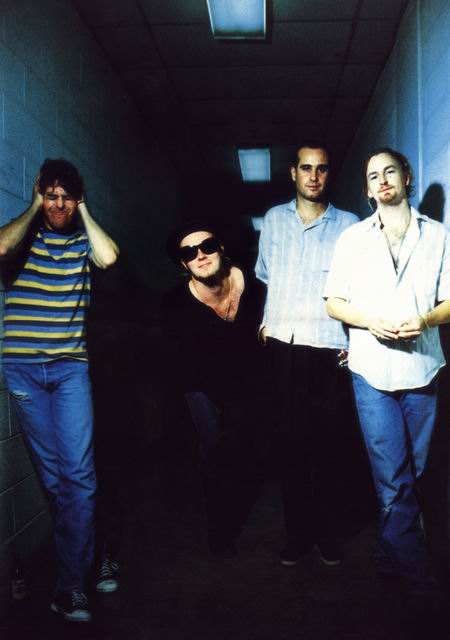
Stone Temple Pilots. Left to right: Robert DeLeo, Scott Weiland, Dean DeLeo, and Eric Kretz.

It's not just about the music, though. The lyrical content is also worth addressing. It's a well-known fact that Scott Weiland is one emotional dude. Each of STP's albums has a very clear theme, apparently based on how Weiland feels during the songwriting process. If the thread carrying through Core is apathy, the thread through Tiny Music drugs, the thread through No. 4 divorce, the thread through Shangri-la Dee Da recovery, and the thread through STP putting the pieces back together, then the thread through Purple is frustration. 

So Purple starts with a declaration of that frustration, when Weiland sings in "Meatplow,"

Fine place for a day full of breakdowns. / Takes more than a meltdown to show us how. / Throw a tack on the road, / Stop the meatplow; / Got a bullet but it ain't mine.
This sets the stage for an album-long manifesto against backstabbing, sniping, criticism, and--in some ways--self-doubt. Yet, as you'll see later, Weiland doesn't necessarily follow his own advice. Still, it's worth keeping "Meatplow" in mind when we move forward on the album.

Fun Fact: I love Stone Temple Pilots, but they don't love my car. I once (accidentally) rear-ended a woman to the strains of "Sour Girl." And just days before my junior year of college began, I was pulled over by a county sheriff's deputy to--you guessed it--"Meatplow."

Tune in tomorrow for a review of "Vasoline"!

Image via Akorra.com.

-Cate-

Wednesday, April 17, 2013

Purple: An Introduction (From the Archives)

In late 2011, I wrote a twelve-post series for my first blog, What We Covet, called "In Defense of Stone Temple Pilots." Because April and May are incredibly busy for me, I'll be republishing them here for your reading pleasure. Enjoy!

* * *

In Defense of Stone Temple Pilots
Or, Why Purple Is One of the Greatest Albums of All Time

Critics hate Stone Temple Pilots.

It's true. Chuck Klosterman once wrote of a band called the Bravery, "Like Stone Temple Pilots [...] before them, the Bravery serve as cultural shorthand: If someone wants to take a stand against inauthentic, unoriginal rock'n'roll, they can simply say, 'I hate the Bravery.'" Rolling Stone and Spin seem to agree, on an institutional level--neither Rolling Stone's "500 Greatest Albums of All Time" (published in 2003), that magazine's "500 Greatest Songs of All Time" (published in 2011), nor Spin's "100 Greatest Albums 1985-Now" (published in 2005) include any of STP's work. And while I understand that such lists may be highly political, subjective, or slaves to the whims of those who compile such lists, there is a very big part of me that refuses to believe that a prolific, talented band such as STP hasn't produced any material worthy of charting in any of these scenarios.

I'm not saying that they're the best band ever; that's definitely the Beatles, no contest. But I feel confident in asserting that STP certainly is not the worst, either (I am looking in your direction, Blink-182). And I'm going to use their second studio album, Purple, to prove it to you.

Front cover artwork for Purple.

A few items of business before we launch into an in-depth review of the album:

1) I am not qualified to judge the actual musical quality of any of these songs. I only have my instincts to guide me, but I feel that they are good ones.

2) Personally, my favorite STP album is No. 4. I do, however, realize that Purple may just be a better album (either way, I stand behind all of their albums, even--dare I say it?--their most recent); this is why I'm campaigning for the inclusion of Purple on "Greatests" lists.

3) As much as it amuses me, "My Second Album" is not a legitimate part of Purple (it's not even a Stone Temple Pilots song), so I won't review it here.

4) Any lyrics cited in posts will be a combination of the printed lyrics in Purple's liner notes--which are sometimes either incomplete or slightly inaccurate--and what one actually hears on the album.

5) So we're all on the same page, you'll find a list of tracks/writing credits and band personnel below. Information here is based on the album's liner notes.

Tracks (Writing Credits)
1) "Meatplow" (D. DeLeo, R. DeLeo)
2) "Vasoline" (D. DeLeo, R. DeLeo, E. Kretz. S. Weiland)
3) "Lounge Fly" (R. DeLeo)
4) "Interstate Love Song" (R. DeLeo)
5) "Still Remains" (D. DeLeo, R. DeLeo)
6) "Pretty Penny" (D. DeLeo)
7) "Silvergun Superman" (D. DeLeo, R. DeLeo)
8) "Big Empty" (D. DeLeo)
9) "'Unglued'" (R. DeLeo, S. Weiland)
10) "Army Ants" (D. DeLeo)
11) "Kitchenware & Candybars" (R. DeLeo)

All lyrics by S. Weiland

Personnel
Scott Weiland, vocals, guitar ("Silvergun Superman), and percussion ("Pretty Penny")
Dean DeLeo, electric and acoustic guitar, percussion ("Pretty Penny"), and drum solo ("Silvergun Superman")
Robert DeLeo, bass, guitar ("Vasoline," "Lounge Fly," "Pretty Penny," "Silvergun Superman," and "Kitchenware & Candybars"), and percussion ("Pretty Penny")
Eric Kretz, drums and percussion ("Vasoline," "Lounge Fly," "Pretty Penny," and "Big Empty")
Brendan O'Brien, producer, percussion ("Meatplow," "Interstate Love Song," "Silvergun Superman," "'Unglued,'" and "Kitchenware & Candybars"), guitar ("Kitchenware & Candybars"), and mellotron ("Army Ants")
Paul Leary, guitar (end solo on "Lounge Fly")

So if you're at all interested in hearing what I have to say about each of these songs, please come back tomorrow to read the first installment--an analysis of "Meatplow"--and ten more days after that for my thoughts on the other tracks.

Image via Fotolog.

-Cate-